

Journal Description
Humanities
Humanities
is an international, peer-reviewed, open access journal on the meaning of cultural expression and perceptions as seen through different interpretative lenses. Humanities is published monthly online by MDPI.
- Open Access— free for readers, with article processing charges (APC) paid by authors or their institutions.
- High Visibility: indexed within Scopus, ESCI (Web of Science), ERIH Plus, and other databases.
- Rapid Publication: manuscripts are peer-reviewed and a first decision is provided to authors approximately 27.8 days after submission; acceptance to publication is undertaken in 4.5 days (median values for papers published in this journal in the second half of 2024).
- Recognition of Reviewers: reviewers who provide timely, thorough peer-review reports receive vouchers entitling them to a discount on the APC of their next publication in any MDPI journal, in appreciation of the work done.
Impact Factor:
0.3 (2023)
Latest Articles
Hölderlin’s and Novalis’ Philosophical Beginnings (1795)
Humanities 2025, 14(4), 84; https://doi.org/10.3390/h14040084 - 1 Apr 2025
Abstract
Philosophers and literary scholars have notoriously struggled with the periodization of Hölderlin’s work, showing particular reluctance to situate it within Early Romanticism. But there can be no doubt that Hölderlin’s philosophical work resides within the context of an anti-foundationalist criticism, which students of
[...] Read more.
Philosophers and literary scholars have notoriously struggled with the periodization of Hölderlin’s work, showing particular reluctance to situate it within Early Romanticism. But there can be no doubt that Hölderlin’s philosophical work resides within the context of an anti-foundationalist criticism, which students of Karl Leonhard Reinhold leveled at his programmatic deduction from a “highest principle” (oberster Grundsatz) in the early 1790s and intensified following Fichte’s lectures (1794/95) on the Science of Knowledge (Wissenschaftslehre). Novalis belonged directly to the circle of Reinhold students, while Hölderlin gained access to it through Friedrich Immanuel Niethammer, his friend from student days in Tübingen and “mentor” in Jena. Niethammer encouraged both Hölderlin and Novalis to contribute to his Philosophisches Journal, conceived as a forum for discussing the pros and cons of foundational philosophy (Grundsatzphilosophie). Novalis’ Fichte-Studies and Hölderlin’s philosophical fragments from 1795/96 can be read as drafts for such an essay. Both men developed similar critiques of Reinhold’s reformulated, subject-centered “highest principle”, the “principle of consciousness” (Satz des Bewusstseins). They argued that according to Reinhold, self-consciousness is a representation, i.e., a binary relationship that provides no explanation for the certainty of unity associated with self-consciousness. Both postulate a transcendent “ground of unity”, which would address this issue while remaining inaccessible to consciousness. My article demonstrates that both men failed to disentangle themselves from the snares of Reinhold’s model of representation, and both transferred the solution for the problem of self-consciousness onto the extra-philosophical medium of art.
Full article
(This article belongs to the Special Issue Hölderlin and Poetic Transport)

Open AccessArticle
Hölderlin: Between Kant and the Greeks
by
Àlex Mumbrú Mora
Humanities 2025, 14(4), 83; https://doi.org/10.3390/h14040083 - 1 Apr 2025
Abstract
In Hyperion, or the Hermit in Greece, Hölderlin introduces two narrative planes: the description of action and the reflection (or memory) of past events. The transition between these points of view is facilitated by the extensive use of metaphor. This paper
[...] Read more.
In Hyperion, or the Hermit in Greece, Hölderlin introduces two narrative planes: the description of action and the reflection (or memory) of past events. The transition between these points of view is facilitated by the extensive use of metaphor. This paper examines Hölderlin’s use of metaphorical language through Plato’s conception of beauty as a link between the sensible and intelligible worlds and Kant’s notion of the “aesthetic idea” as an imaginative representation that “occasions much thinking” (viel zu denken veranlasst). This analysis shows how both sources constitute the theoretical framework for the construction of a New Mythology, as outlined in Das älteste Systemprogramm des deutschen Idealismus.
Full article
(This article belongs to the Special Issue Hölderlin and Poetic Transport)

Open AccessArticle
What Makes a Version of a Work a Version of That Work?
by
Alberto Voltolini
Humanities 2025, 14(4), 82; https://doi.org/10.3390/h14040082 - 1 Apr 2025
Abstract
In this paper, I want to defend the following claim. There is a good chance of keeping the Meinongian account of the individuation of fictional works and applying it to the individuation of versions of such a work, provided one properly takes into
[...] Read more.
In this paper, I want to defend the following claim. There is a good chance of keeping the Meinongian account of the individuation of fictional works and applying it to the individuation of versions of such a work, provided one properly takes into account some factors characterizing the make-believe games underlying the production of such versions, namely factors characterizing having to do with the remaking of such games, in order to explain why such versions are versions of that work, not mere individual works just as any other.
Full article
(This article belongs to the Special Issue The Interpretation of Fictional Characters in Literary Texts: History of Literary Criticism, Philosophy and Formal Ontologies)
Open AccessArticle
Delineating Ecoethics in Alexis Wright’s Carpentaria and The Swan Book
by
Minimol P G and Preeti Navaneeth
Humanities 2025, 14(4), 81; https://doi.org/10.3390/h14040081 - 1 Apr 2025
Abstract
Literary works of contemporary Australian Aboriginal writers are widely read for their engagement with expressions of resilience and resistance against colonial supremacy. But these works have a greater significance in modern times, as they carry forward the Aboriginal cultural traditions of caring for
[...] Read more.
Literary works of contemporary Australian Aboriginal writers are widely read for their engagement with expressions of resilience and resistance against colonial supremacy. But these works have a greater significance in modern times, as they carry forward the Aboriginal cultural traditions of caring for the country (an Aboriginal concept that comprises people, their culture, and all living and non-living entities in a place, including the land) and in vocalising the concerns that arise from grief for the loss of the natural environment. This paper investigates how Alexis Wright, in her postmillennial novels Carpentaria (2006) and The Swan Book (2013), redefines dominant ethical and aesthetic frameworks and tries to delineate ecoethics in these novels through a critical analysis of the representation of relationality and interconnectedness between Aboriginal people and their natural environment. By exploring the Aboriginal belief system as represented in the texts and its role in shaping Aboriginal environmental values, this paper argues that Carpentaria and The Swan Book embody ecoethics and offer a reimagining of deep ecological perspectives in contemporary literature.
Full article
(This article belongs to the Special Issue World Mythology and Its Connection to Nature and/or Ecocriticism)
Open AccessArticle
Nature, Nurture, and Empowerment: An Ecofeminist Reading of Utkarsh Patel’s Mythological Fiction Shakuntala: The Woman Wronged
by
Supriya Maity, Pragya Shukla, Neetu Purohit and Usnis Banerjee
Humanities 2025, 14(4), 80; https://doi.org/10.3390/h14040080 - 31 Mar 2025
Abstract
The present research revisits the mythological fiction of Shakuntala: The Woman Wronged (2015) through an ecofeminist lens. Author Utkarsh Patel approaches the legendary tale of submissive Shakuntala and recreates it by arming her with the attributes of resilience, assertiveness, and compassion. Her deep
[...] Read more.
The present research revisits the mythological fiction of Shakuntala: The Woman Wronged (2015) through an ecofeminist lens. Author Utkarsh Patel approaches the legendary tale of submissive Shakuntala and recreates it by arming her with the attributes of resilience, assertiveness, and compassion. Her deep bond with nature equips her with the strength to fight against patriarchal strictures. Based on the study of ecofeminism, this paper draws parallels between the exploitation of women and nature at the hands of mercenary and oppressive forces. An analysis of this work suggests that nature itself provides strength and succour and is also a source of empowerment. The strength gained through communion with nature allows her to make her voice heard. The ecofeminist perspective reveals how Shakuntala’s connection with nature offers her a sanctuary where she can explore her identity and voice, unimpeded by the norms that seek to suppress her. Her love for and defence of the environment transcends mere ecological concern—it becomes a catalyst leading to her transformation. Additionally, Shakuntala’s deep connection with Aranyani, the Forest Goddess, aligns with the concept of nature as a mother figure. By drawing attention to the intertwined dynamics of nature, nurture, and empowerment, this research celebrates and propagates the harmony between nature, feminine forces, and their transformative power.
Full article
(This article belongs to the Special Issue World Mythology and Its Connection to Nature and/or Ecocriticism)
Open AccessArticle
Cassava/Yuca/Manioc
by
Keja Lys Valens
Humanities 2025, 14(4), 79; https://doi.org/10.3390/h14040079 - 31 Mar 2025
Abstract
Cassava/Yuca/Manioc: This staple of Indigenous Caribbean diets has gone from being decried for its danger and denigrated for its supposed inferiority to wheat by the early colonists, to being among the few foods that nourished slaves, to creolizing into postcolonial national dishes, and
[...] Read more.
Cassava/Yuca/Manioc: This staple of Indigenous Caribbean diets has gone from being decried for its danger and denigrated for its supposed inferiority to wheat by the early colonists, to being among the few foods that nourished slaves, to creolizing into postcolonial national dishes, and to being touted as a wonder food resistant to the climate disaster and dietary breakdowns that manifest the slow violence of the colonial project. Is the uplifting of cassava the rise of the Caribbean plot, the next step in neocolonial globalist expropriation of things Caribbean, or something of both? This paper traces discourses of cassava from the writings of early colonialists like Pere Labat through Caribbean cookbooks of the independence era where it was creolized with African, European, and Asian techniques and traditions and into postcolonial diasporic food writing and commercial projects from Carmeta’s Bajan food independence through contemporary global agriculture projects promoting cassava. Cassava/Yuca/Manioc, this paper argues, continues to be deterritorialized on a global scale at the same time as, in the Caribbean, it continues to nourish locally grounded persistence, adaptation, resistance, and thriving.
Full article
(This article belongs to the Special Issue Rise of a New World: Postcolonialism and Caribbean Literature)
Open AccessArticle
‘Ring the Bells’: Sound and Silence in Garth Nix’s Old Kingdom
by
Sean Williams
Humanities 2025, 14(4), 78; https://doi.org/10.3390/h14040078 - 28 Mar 2025
Abstract
Australian author Garth Nix has set six critically acclaimed and internationally bestselling novels and several shorter works in and around the fictional world of the Old Kingdom, beginning with Sabriel (1995) and continuing most recently with Terciel & Elinor (2021). This loose series
[...] Read more.
Australian author Garth Nix has set six critically acclaimed and internationally bestselling novels and several shorter works in and around the fictional world of the Old Kingdom, beginning with Sabriel (1995) and continuing most recently with Terciel & Elinor (2021). This loose series of texts, with its bellringing protagonists, is the prime contributor to his reputation as an author of high fantasy fiction, although he is also marketed as and known for writing science fiction and other related subgenres. Most notably, his work prominently features elements of the Gothic. This aspect of his work and the ways in which it creates tension within the “high” fantasy genre becomes increasingly apparent when examined through the lens of sound—a critical method that has potential for charting the entanglements of this genre with other popular genres of fiction.
Full article
(This article belongs to the Special Issue Music and the Written Word)
Open AccessArticle
A Restless Nature
by
Susan Byrne
Humanities 2025, 14(4), 77; https://doi.org/10.3390/h14040077 - 27 Mar 2025
Abstract
During the Spanish Renaissance, curiosity was the catalyst for change and creativity. Earlier philosophical stories regarding the perils and pitfalls of curiosity, written by Plotinus and Hermes Trismegistus, were adapted to a quite positive end: human creativity in letters.
Full article
(This article belongs to the Special Issue Curiosity and Modernity in Early Modern Spain)
Open AccessArticle
“You Two Are the Bad Guys!” Intergenerational Equity, Ecophobia, and Ecocentric Card Games in Disney’s Strange World (2022)
by
Roberta Grandi
Humanities 2025, 14(4), 76; https://doi.org/10.3390/h14040076 - 27 Mar 2025
Abstract
Disney’s Strange World (2022) explores the themes of “energy unconscious”, “intergenerational equity”, and “ecophobia”, focusing on the legacy parents leave to their children. The film centers on three generations of men, each representing different attitudes towards nature. Jaeger Clade, the grandfather, embodies colonialist
[...] Read more.
Disney’s Strange World (2022) explores the themes of “energy unconscious”, “intergenerational equity”, and “ecophobia”, focusing on the legacy parents leave to their children. The film centers on three generations of men, each representing different attitudes towards nature. Jaeger Clade, the grandfather, embodies colonialist values, viewing nature as a hostile force to be conquered. His son, Searcher, an intensive farmer, sees nature as a battleground between useful beings and pests, focusing on improving society through domestication. In contrast, Ethan, Searcher’s teenage son, adopts an ecocentric perspective. His worldview is expressed through the card game Primal Outpost, where he and his friends embrace symbiosis, interconnectedness, and the rejection of the man-nature divide. Ethan is the first to recognize that their ecosystem is a living organism reminiscent of the Gaia Hypothesis, advocating for a paradigm shift that the older generations fail to grasp. The article analyzes Strange World as a cli-fi allegory, urging humanity to choose between being parasitic destroyers or symbiotic contributors to ecological recovery. The film, while offering a simplified solution to climate change, presents a comic apocalyptic vision where youth-driven hope for change challenges older, ecophobic attitudes and offers a transformative, ecotopian message.
Full article
(This article belongs to the Special Issue Eco-Rebels with a Cause: Representations and Explorations of Politics and Activism in Children's and YA Literature)
Open AccessArticle
Friendly Affection and Trans-Racial Community Building in Kathryn Stockett’s The Help
by
Wenjun Yi
Humanities 2025, 14(4), 75; https://doi.org/10.3390/h14040075 - 26 Mar 2025
Abstract
The Help, winner of the 2009 Exclusive Books Boeke Prize, is the debut novel of American author Kathryn Stockett. Taking Jacques Derrida’s “Politics of Friendship” as the major theoretical framework, this research examines the transformation from the white community and the Black
[...] Read more.
The Help, winner of the 2009 Exclusive Books Boeke Prize, is the debut novel of American author Kathryn Stockett. Taking Jacques Derrida’s “Politics of Friendship” as the major theoretical framework, this research examines the transformation from the white community and the Black community to the trans-racial community through the emotional interaction between white mistresses and Black maids. The distinctively exclusive white community perpetuates racial discrimination and confronts Black others with hostility, while the racially injured Black people can only seek mutual refuge and friendly affection in the Black community. On the surface, the white community and the Black community are antagonistic. However, the racist system has entangled the emotions and fates of the three protagonists with different identities. In the book, when the Black people open their hearts to tell their stories and gain support and trust within the community, white people not only witness social injustice, but also unconditionally assume responsibility for the “other” when facing Black “others”. Based on the “law of unconditional love”, the novel breaks through the inherent limitations based on race, class, geography, etc., and calls for the advent of the politics of friendship and the formation of trans-racial communities.
Full article
(This article belongs to the Special Issue Comparative Literature and World Literature: Toward a Global Cultural Community through a New Cosmopolitanism)
Open AccessArticle
Archival Narrative Justice in Valeria Luiselli’s Lost Children Archive
by
Dharshani Lakmali Jayasinghe
Humanities 2025, 14(4), 74; https://doi.org/10.3390/h14040074 - 26 Mar 2025
Abstract
Valeria Luiselli’s Lost Children Archive (2019) captures the challenges that “lost”, or undocumented children experience in their attempts to cross the US-Mexico border and provides a stringent critique of the unjust and arbitrary nature of border laws. In this paper, I argue that
[...] Read more.
Valeria Luiselli’s Lost Children Archive (2019) captures the challenges that “lost”, or undocumented children experience in their attempts to cross the US-Mexico border and provides a stringent critique of the unjust and arbitrary nature of border laws. In this paper, I argue that Luiselli’s novel merges the narrative with the archival to form an “archival novel”, which generates what I call “archival narrative justice”, a form of achieving justice through an archival narrative when legal and institutional justice is absent or inadequate. In doing so, I demonstrate how the narrative form and the practice of archiving, both independently and collectively, are significant avenues for re-conceptualizing “justice” through generating counterhistories and making visible multiple marginalized perspectives. I connect Luiselli’s archival-narrative practice with how the borderlands house such counterhistories by building on Gloria Anzaldúa’s work on borderlands. I develop the concept of “borderland as archive” to understand how Lost Children Archive recognizes the interstitial space of the borderlands as coded with the knowledges, histories, memories, lived experiences, and resistance of border crossers and border dwellers, from undocumented immigrants to dispossessed Native Americans who have been illegalized by settler-colonial and capitalistic immigration laws.
Full article
(This article belongs to the Special Issue Imagining the Law: American Literature and Justice)
Open AccessArticle
Code Word Cloud in Franz Kafka’s “Beim Bau der Chinesischen Mauer” [“The Great Wall of China”]
by
Alex Mentzel
Humanities 2025, 14(4), 73; https://doi.org/10.3390/h14040073 - 25 Mar 2025
Abstract
Amidst the centenary reflections on Franz Kafka’s legacy, this article explores his work’s ongoing resonance with the digital age, particularly through the lens of generative AI and cloud computation. Anchored in a close reading of Kafka’s “Beim Bau der chinesischen Mauer”, this study
[...] Read more.
Amidst the centenary reflections on Franz Kafka’s legacy, this article explores his work’s ongoing resonance with the digital age, particularly through the lens of generative AI and cloud computation. Anchored in a close reading of Kafka’s “Beim Bau der chinesischen Mauer”, this study interrogates how the spatial and temporal codes embedded in the narrative parallel the architectures of contemporary diffusion systems at the heart of AI models. Engaging with critical theory, media archaeology, and AI discourse, this article argues that the rise of large language models not only commodifies language but also recasts Kafka’s allegorical critiques of bureaucratic opacity and imperial command structures within a digital framework. The analysis leverages concepts like Kittler’s code, Benjamin’s figural cloud, and Hamacher’s linguistic dissemblance to position Kafka’s parables as proto-critical tools for examining AI’s black-box nature. Ultimately, the piece contends that Kafka’s text is less a metaphor for our technological present than a mirror reflecting the epistemological crises engendered by the collapse of semantic transparency in the era of algorithmic communication. This reframing invites a rethinking of how narrative, code, and digital architectures intersect, complicating our assumptions about clarity, control, and the digital regimes shaping contemporary culture.
Full article
(This article belongs to the Special Issue Franz Kafka in the Age of Artificial Intelligence)
Open AccessCorrection
Correction: Campbell (2019). Extractive Poetics: Marine Energies in Scottish Literature. Humanities 8: 16
by
Alexandra Campbell
Humanities 2025, 14(4), 72; https://doi.org/10.3390/h14040072 - 25 Mar 2025
Abstract
Text Correction [...]
Full article
Open AccessArticle
Towards an Ontology of the Theatrical Character: Insights from Niccolò Machiavelli’s Comedies
by
Giorgia Gallucci
Humanities 2025, 14(4), 71; https://doi.org/10.3390/h14040071 - 24 Mar 2025
Abstract
This contribution aims to explore the composite nature of the theatrical character, with a focus on the comedy genre. The objective is to outline a theoretical framework for the development of a formal ontology that encompasses the editorial, performative, and receptive dimensions involved
[...] Read more.
This contribution aims to explore the composite nature of the theatrical character, with a focus on the comedy genre. The objective is to outline a theoretical framework for the development of a formal ontology that encompasses the editorial, performative, and receptive dimensions involved in the creation of dramatic characters. This article incorporates three perspectives: those of the author, the actor, and the spectator/reader. Drawing on the research of Manfred Pfister and Anne Ubersfeld, this contribution highlights how the study of theatrical characters requires specific methodologic attention, especially when compared with those of the narrative character, given the medial duality of the dramatic context. Since the theatrical character is the product of complex interplay between intentions and perceptions, the role of both the audience and the reader merit particular attention. The comedy genre lends itself to a categorical approach due to the historic configuration of stock types in classical comedy and masks in commedia dell’arte. Theoretical reflections will be supported by an analysis of Machiavelli’s comedies as a case study. The Machiavellian example most effectively illustrates the critical stratification underlying the perception of a character and the classes and properties that are essential to formalize its digital ontology.
Full article
(This article belongs to the Special Issue The Interpretation of Fictional Characters in Literary Texts: History of Literary Criticism, Philosophy and Formal Ontologies)
Open AccessArticle
The Eye and the Flesh: Céline, Bataille, and the Fascination with Death
by
Alexis Louis Chauchois
Humanities 2025, 14(4), 70; https://doi.org/10.3390/h14040070 - 24 Mar 2025
Abstract
This paper argues that Louis-Ferdinand Céline and Georges Bataille use voyeurism as a transgressive mechanism to confront death through the female body, a paradoxical site of life and decay. Though Céline’s clinical, disenchanted gaze contrasts with Bataille’s erotic, metaphysical quest, both employ the
[...] Read more.
This paper argues that Louis-Ferdinand Céline and Georges Bataille use voyeurism as a transgressive mechanism to confront death through the female body, a paradoxical site of life and decay. Though Céline’s clinical, disenchanted gaze contrasts with Bataille’s erotic, metaphysical quest, both employ the act of seeing to reveal death’s presence within vitality. In Céline’s works, voyeurism shifts from erotic curiosity to cold observation, framing the female body as a sterile emblem of mortality. In Bataille’s, it becomes participatory, merging ecstasy with dissolution in a sacred yet destructive form. Drawing on Freud and Sodom motifs, this study shows how their gazes transform the female body into a lens for existential finitude, challenging life–death boundaries in 20th-century French literature.
Full article
(This article belongs to the Section Literature in the Humanities)
Open AccessArticle
Precarious Childhoods in Malayalam Films: Negotiating Precarity and Posthumanism in Ottaal and Veyilmarangal
by
Rona Reesa Kurian and Preeti Navaneeth
Humanities 2025, 14(4), 69; https://doi.org/10.3390/h14040069 - 21 Mar 2025
Abstract
This article considers two Malayalam films, each of which uses ‘the child’ to reflect on ‘precarious childhood’. Ottaal (2014, Dir. Jayaraj) and Veyilmarangal (2019, Dir. Bijukumar Damodaran) present the ontological relationality of their child characters within their context and the political and social
[...] Read more.
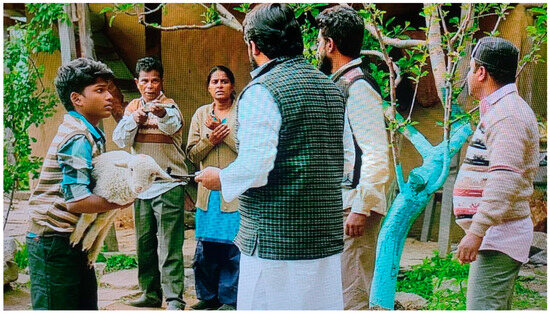
This article considers two Malayalam films, each of which uses ‘the child’ to reflect on ‘precarious childhood’. Ottaal (2014, Dir. Jayaraj) and Veyilmarangal (2019, Dir. Bijukumar Damodaran) present the ontological relationality of their child characters within their context and the political and social realities of the people in Kerala. The ecological disasters, economic catastrophes, and multilayered forms of social abjection push the children out of human primacy, predominantly through their birth and existence as ‘nameless’ Dalits. The child characters, who contrast with the adults, negotiate a space for themselves amidst the question of belongingness through their relation with animals and the environment around them during the phase(s) of displacement. Borrowing Haraway’s concept of ‘companion species’, we expound on their assemblage with the environment through which they are able to survive the complex realities of daily life. Furthermore, the children are singularly and effectively extensions of animal personhood in their inability to determine the terms of their existence. In response to the larger question of precarity and childhood in the context of Kerala, this paper explores how these Malayalam films, by realistically portraying the idea that human primacy is oblivious to its precariousness, address the ecological predicament and the interconnectedness of all living things, emphasizing values of cohabitation and mutual care, which are central themes in posthumanist thought.
Full article
(This article belongs to the Special Issue Child Migration Experiences in Fiction, Film and Visual Art)
►▼
Show Figures

Figure 1
Open AccessArticle
Indian “Boarding School” and Chinese “Bachelor Society”: Forced Isolation, Cultural Identity Erasure, and Literary Resilience in American Ethnic Literatures
by
Li Song
Humanities 2025, 14(4), 68; https://doi.org/10.3390/h14040068 - 21 Mar 2025
Abstract
Between 1871 and 1969, Native Americans (American Indians) endured the U.S. Federal Indian Boarding School system, while Chinese Americans faced enduring impacts from the Chinese Exclusion Act (1882–1943). Drawing on historical sources, this paper examines literary works by and about Native Americans and
[...] Read more.
Between 1871 and 1969, Native Americans (American Indians) endured the U.S. Federal Indian Boarding School system, while Chinese Americans faced enduring impacts from the Chinese Exclusion Act (1882–1943). Drawing on historical sources, this paper examines literary works by and about Native Americans and Chinese Americans, focusing on their sufferings under forced isolation policies. Through works like Ceremony and Gardens in the Dunes by Leslie Marmon Silko and Eat a Bowl of Tea by Louis Chu, this study illustrates how systematic oppression, characterized by erasure of cultural identity, manifested through institutions such as “boarding school” and “bachelor society”. It explores how forced policies (like assimilation and isolation) and institutional oppression, through cultural erasure and the severing of family ties, dismantled family structures, weakened cultural transmission, and led to identity crises, inter-generational alienation, and psychological trauma in marginalized communities. These ethnic narratives not only document histories of oppression but also highlight the ethnic groups’ resilience and their efforts to reconstruct multicultural identity through cultural heritage and community ties under multifaceted pressures.
Full article
(This article belongs to the Special Issue Comparative Literature and World Literature: Toward a Global Cultural Community through a New Cosmopolitanism)
Open AccessArticle
Loveable Lack: The Reimagined Wild of “Real” Bears
by
Elizabeth Ritsema
Humanities 2025, 14(3), 67; https://doi.org/10.3390/h14030067 - 19 Mar 2025
Abstract
The image of the bear and its relationship to the human undergoes many representations in children’s literature. Their bodies range from cute and squishable teddy bears to non-fiction representations of wild bears. For example, the lone polar bear, a popular visual device for
[...] Read more.
The image of the bear and its relationship to the human undergoes many representations in children’s literature. Their bodies range from cute and squishable teddy bears to non-fiction representations of wild bears. For example, the lone polar bear, a popular visual device for expressing the “slow violence” of climate change, coined by Rob Nixon in 2011. This gray area then invites one to consider how these two opposing states influence one another in the context of conversations around climate change. Given the widespread adoption of the polar bear as an emblem of climate change, this article addresses how polar bear imagery is translated into modern children’s literature when it often draws on cute aesthetics. Cuteness then calls into question how ‘real’ bears have been reimagined into fictional settings and whether relationships between child and bear can provide commentary on inspiring environmental activism. I explore Hannah Gold’s The Last Bear and its sequel, Finding Bear, as borderline ecopedagogical texts which highlight the tension created when a typically cute subject is used to encourage environmental activism amongst its younger readerships.
Full article
(This article belongs to the Special Issue Eco-Rebels with a Cause: Representations and Explorations of Politics and Activism in Children's and YA Literature)
Open AccessArticle
Phenomenology of Embodied Detouring
by
Wendelin M. Küpers
Humanities 2025, 14(3), 66; https://doi.org/10.3390/h14030066 - 14 Mar 2025
Abstract
This paper adopts a phenomenological and interdisciplinary approach to explore the embodied dimensions of place and movement as they pertain to travel and tourism. By drawing on the phenomenology of Merleau-Ponty, this study examines how the living body intermediates experiences of place and
[...] Read more.
This paper adopts a phenomenological and interdisciplinary approach to explore the embodied dimensions of place and movement as they pertain to travel and tourism. By drawing on the phenomenology of Merleau-Ponty, this study examines how the living body intermediates experiences of place and performed mobility across various touring modalities. In particular, it introduces the concept of embodied “detouring” as a distinct form of relationally placed mobility. The paper further explores the notion of “heterotouropia” and its connection to detouring in addition to addressing the ideas of “other-placing” and “other-moving” as ways to engage in indirect pathways. The paper concludes by presenting the implications, open questions and perspectives related to detouring and sustainable forms tourism and mobilities.
Full article
(This article belongs to the Special Issue The Phenomenology of Travel and Tourism)
Open AccessArticle
‘Enter Kent, Gloster, and Bastard’: Beginning King Lear and the Choice of the Audience
by
Peter Holland
Humanities 2025, 14(3), 65; https://doi.org/10.3390/h14030065 - 13 Mar 2025
Abstract
The title page of the first quarto of Shakespeare’s 1608 King Lear foregrounds many things: Shakespeare’s name in the largest font used, an emphasis that this King Lear is “HIS”, the fascination with Edgar as “Tom of Bedlam” and the
[...] Read more.
The title page of the first quarto of Shakespeare’s 1608 King Lear foregrounds many things: Shakespeare’s name in the largest font used, an emphasis that this King Lear is “HIS”, the fascination with Edgar as “Tom of Bedlam” and the fact that this is the play “As it was played before the Kings Maiestie at Whitehall upon S. Stephans night in Christmas Hollidayes”. The particularity of that moment and its complex implications has been explored before, of course, but there are new ways to rethink that moment when the play met a particular gathering of spectators in a particular room on that day in the Christmas holidays. And, from that interaction, this article moves on to consider other performances that define such purposive positionings of the play. It is one thing to, say, perform King Lear in the repertory of the RSC and something very different to perform it, for example, to an audience of carers for the elderly as part of Theatre of War’s King Lear Project. As Kent and Gloucester begin the play, so King Lear negotiates with its audiences, usually made up of play-goers who have chosen the play and sometimes those who have been chosen by the play.
Full article
(This article belongs to the Special Issue Shakespearean Performance: Contemporary Approaches, Findings, and Practices)
Highly Accessed Articles
Latest Books
E-Mail Alert
News
2 April 2025
MDPI INSIGHTS: The CEO's Letter #21 - Annual Report, Swiss Consortium, IWD, ICARS, Serbia
26 March 2025
Meet Us at the Eighth Annual Conference of the European Academy of Religion (EuARe 2025), 8–12 July 2025, Vienna, Austria
Topics
Topic in
Education Sciences, EJIHPE, Healthcare, Humanities, Societies, IJERPH
Teaching Social Sciences and Humanities in Medicine, Allied Health and Social Care
Topic Editors: Costas S Constantinou, Lisa Dikomitis, Eirini Kampriani, Jeni HardenDeadline: 30 June 2025
Topic in
Businesses, Economies, Humanities, Land, Sustainability, Tourism and Hospitality, Urban Science
Human–Environmental Relations: Ecotourism and Sustainability
Topic Editors: Tamara Gajić, Minja Bolesnikov, Aleksandar ErcegDeadline: 15 July 2025
Conferences
Special Issues
Special Issue in
Humanities
Hybridity and Border Crossings in Contemporary North American Poetry
Guest Editor: Ann KenistonDeadline: 15 April 2025
Special Issue in
Humanities
Homes and Homelands: Leaving a Homeland/Creating a Home
Guest Editor: Dina AminDeadline: 25 April 2025
Special Issue in
Humanities
Imagining a Decolonial Future through Indigenous Activism
Guest Editor: Drew LopenzinaDeadline: 30 April 2025
Special Issue in
Humanities
World Mythology and Its Connection to Nature and/or Ecocriticism
Guest Editor: Rachel McCoppinDeadline: 15 May 2025